Booking a rental car seems simple: enter your destination, choose the cheapest car and pay. Yet with car hire, the lowest price in the search results can ultimately turn out to be one of the most expensive options.
The difference is not just in the rental price. Insurance, the excess, an additional driver, airport charges, border crossings, fuel policies and even the country version of the website you book on can change the final price.
Looking a little beyond the first comparison website can therefore save you a surprising amount.
In this guide, we explain how to approach car hire as a smart traveller — including lesser-known tricks involving rate codes, foreign websites and a booking platform that, despite its name, covers much more than just America: HappyToursUSA.
Use a comparison website as your starting point
A comparison website is an excellent starting point. You can quickly see:
- which rental companies operate there;
- roughly what a particular car category costs;
- how large the price differences are;
- which locations are available.
Treat the lowest price you find as a benchmark, rather than automatically as the deal you should book.
Then search for the same rental directly with the rental company and, if useful, through other booking channels. A broker may have an attractive wholesale rate, while the rental company itself may offer a member rate or partner discount.
NOMADIY tip
When comparing, note down:
rental company + car category + rental period + total price + insurance + excess + additional driver.
Then compare those complete packages.
A car costing €24 a day is not cheaper than one costing €32 if hundreds of euros in insurance and additional-driver charges are added afterwards.
Compare packages, not daily rates.
HappyToursUSA: much more interesting than the name suggests
One website we almost always include in our comparison is HappyToursUSA.com.
For clarity: NOMADIY has no affiliation with Happy Tours and receives no payment when you book through this company. We mention the website because we have had very good experiences with it ourselves when renting cars in North and South America and in several European countries.
The name is somewhat misleading. Happy Tours is not an American car rental company, but an intermediary/wholesaler offering rates from major rental companies.
And it does so worldwide.
Alongside the United States and Canada, you can find rental cars there in France, Spain, Portugal, Germany, Italy, the Netherlands, the United Kingdom, Chile, Argentina, Brazil and Mexico, for example.
You are therefore just as likely to find an interesting Happy Tours deal for Amsterdam, Paris or Santiago as for Miami.
Why can Happy Tours be cheaper?
Happy Tours works with promotional and wholesale rates. As a result, the same car from Hertz, Avis, Budget, Dollar, Thrifty or SIXT, for example, may be priced differently from a direct search with the rental company.
Pay close attention to your country of residence/origin. Some rates are specifically intended for international travellers.
Always click one step further
Do not stop at the first price you see on Happy Tours.
With some rates, you can click through and then choose from several rental plans. A more expensive plan may already include:
- CDW/LDW;
- supplemental liability cover;
- an additional driver;
- other extra benefits.
A basic rate of €350 to which you later have to add insurance and a second driver can therefore end up costing more than a €440 package that already includes everything.
Happy Tours lists CDW/LDW among the inclusions in its current promotional rates. Depending on the country and chosen plan, supplemental liability cover and an additional driver may also be included.
Always look at what the rental plan includes, rather than just the first search result.
You can often find the reservation directly with the rental company
After booking, you receive a reservation or confirmation code from the actual rental company.
In many cases, you can enter that code directly on the website of Hertz, Avis or another rental company, for example. You can then view and check your reservation there as well.
We find this a useful extra check: you book through Happy Tours, but can then see that the actual rental company has your reservation correctly recorded in its system.
Useful when prices change
Under the current Happy Tours terms, you pay for the rental directly to the rental company and are not asked for credit card details when making the reservation.
That makes it worth securing a rate with suitable cancellation terms early and searching again later.
Find a better price later? Book the new rate first, then cancel the old reservation.
Of course, always recheck the current cancellation terms for your specific booking.
Search smarter: foreign websites, rate codes and loyalty programmes
Try different official country websites
International car rental companies have websites for different markets.
The German, French, Dutch, British and international versions of the same rental company do not necessarily show exactly the same rate or package.
It can therefore be worth checking, for example:
- the Dutch website;
- the German .de website;
- the French website;
- the British website;
- the international .com website.
This can be particularly useful for international rentals because the mix of insurance and promotions may differ by sales market.
But always use your actual country of residence.
Finding a cheaper German rate is fine. Pretending to live in Germany to get a residents-only rate is another matter. Certain rates may require proof of residence at collection.
Test rate codes you are legitimately eligible for
Alongside ordinary discount codes, car rental companies use various types of partner and rate codes.
At Hertz, for example, you may come across codes such as:
- CDP – Counter Discount Program;
- PC – Promotion Coupon;
- RQ – Rate Code;
- CV – Convention Number.
Avis uses AWD – Avis Worldwide Discount, among others. Other rental companies have similar systems.
Such a code may come from, for example:
- an employer;
- a business programme;
- a credit card;
- an airline or hotel programme;
- an association;
- a university or alumni organisation;
- a public promotion.
Sometimes a code only provides a discount. Sometimes a rate is more attractive because it includes an additional driver or other benefits, for example.
Always compare it with the normal total price.
Do not simply use corporate codes found online
Large lists of corporate codes circulate online.
The fact that a booking system accepts a code does not automatically mean you are entitled to use it.
You may be asked for proof of employment, membership or another qualifying condition at collection.
A valid 10% discount is better than a 30% discount that turns out to be invalid at the counter.
Join the loyalty programme for free
Many major rental companies offer free loyalty programme membership.
Even if you do not rent often, this can be useful straight away. Depending on the rental company and location, benefits may include:
- member rates;
- faster processing;
- saved preferences;
- points or rental credits;
- a separate queue;
- sometimes more flexibility at collection.
The biggest benefits are often reserved for higher status levels, but even free basic membership can provide advantages.
Sign up before booking, then compare the logged-in price with the public price.
Insurance: what does ‘fully insured’ actually mean?
“Full coverage” does not automatically mean you will have nothing to pay or advance if damage occurs.
There are two fundamentally different arrangements.
Insurance directly with the rental company
With Super CDW or a similar product, for example, the rental company reduces the excess, sometimes to zero.
This is usually the simplest option if damage occurs, but it can be relatively expensive.
External insurance or broker cover
With this arrangement, the rental company’s normal excess may remain in place.
If the rental company charges you €1,200 after damage, for example, you then claim that amount from the external insurer.
This can be considerably cheaper, but it means you need enough available credit to cover the amount yourself initially.
Always check whether ‘full coverage’ actually reduces the excess with the rental company, or simply means you can claim it back later.
North America deserves extra attention
The insurance structure in the United States and Canada differs from that in Europe.
Special rates that already include CDW/LDW and supplemental liability cover, for example, can be attractive for international travellers.
For a rental in North America, check at least:
- CDW/LDW;
- liability cover such as SLI/LIS;
- the maximum liability cover;
- an additional driver;
- the toll arrangement;
- the young-driver fee;
- the one-way fee.
Do not rely solely on the word insurance.
Credit card insurance
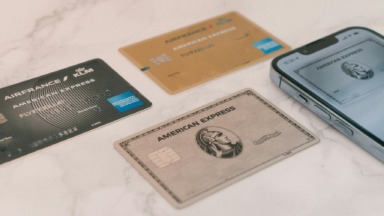
Some premium credit cards provide rental car cover.
Check, among other things:
- the countries in which the cover applies;
- the maximum rental duration;
- the maximum vehicle value;
- excluded vehicle categories;
- glass and tyres;
- the roof and underbody;
- theft;
- liability;
- whether you must decline the rental company’s CDW;
- whether the entire rental must be paid with that card.
Included insurance is only useful if your specific rental actually falls within the terms.
Make sure you have enough available credit on your card
The deposit for a rental car can be substantial.
Look not just at your overall spending limit, but also at how much credit is actually available when you collect the car.
Check before departure:
- does the credit card have to be in the main driver’s name? Usually, yes!
- is a debit card accepted?
- how much is the deposit?
- is the deposit higher if you decline certain insurance products?
- do you need to show a physical card?
Do not assume a rental company treats a Visa Debit card the same way as a Visa Credit card.
More ways to influence the price
Try a day longer or shorter
Car rental prices are not linear.
Rental companies use daily, weekend and weekly rates, for example. As a result, a seven-day rental may be relatively cheaper than six days.
Consider testing:
- collection a day earlier;
- return a day later;
- six days versus seven;
- seven days versus eight;
- a slightly different collection time.
Sometimes this changes the entire rate category.
Watch the 24-hour rule
A rental day is generally calculated per 24 hours.
If you collect the car at 10:00 and book its return five days later at 11:00, that single hour may trigger an extra rental day.
Check the effect of the return time.
Compare airport and city locations
An airport location is convenient, but may be more expensive because of location and airport charges.
Consider also searching at:
- a railway station;
- a city centre;
- a location just outside the airport.
Factor in the cost and time of getting to that location.
One-way rental? Search both directions
Do you want to drive from Los Angeles to San Francisco, for example, and is your itinerary flexible?
Search both:
Los Angeles → San Francisco
and:
San Francisco → Los Angeles.
One-way fees and availability may differ by direction because rental companies take the location of their fleet into account.
Check border crossings in advance
A rental car in Europe is not automatically allowed into every European country.
Restrictions or surcharges may depend on:
- the destination;
- the rental company;
- the vehicle category;
- the car brand;
- the border.
Check this when booking, rather than waiting until you reach the counter.
Additional driver? Include the cost from the start
A surcharge of €10 or €15 a day seems modest, but quickly adds up during a long rental.
Check whether a more comprehensive rate, loyalty benefit or partner code already includes an additional driver.
A higher base rate can therefore end up being cheaper.
Prefer full-to-full
The clearest fuel policy is generally:
collect full, return full.
Refuel yourself shortly before returning the car and keep the fuel receipt.
This helps you avoid high charges for fuel topped up by the rental company.
At collection: photograph more than you think you need
Before driving away, take photos and preferably a short video all around the car.
Record at least:
- all four sides;
- the bumpers;
- the wheels;
- the tyres;
- the windscreen;
- the roof;
- the interior;
- the fuel level;
- the mileage.
Then check that any existing damage has been correctly recorded.
Ask how to report damage that has not yet been recorded
The procedure differs by rental company and sometimes by location.
At one branch, clear photos may be enough. Elsewhere, unrecorded damage must be sent to a specific email address or reported through a digital form within a short time limit.
At collection, ask explicitly:
“What should I do if I discover existing damage after collection that has not been recorded?”
If necessary, also ask:
- within what time limit you must report it;
- which email address to use;
- which online form to use;
- which photos are needed.
Keep a sent email or confirmation with your rental documents.
At return: have the car checked together if possible
Are you returning the car during opening hours and do you have enough time?
Ask whether a staff member can inspect the car with you.
If possible, walk around the car together.
If a staff member spots a scratch or dent that was not recorded at collection, you can immediately show your photo or video proving that the damage was already there.
That avoids a dispute days or weeks later.
If possible, also ask for a receipt or digital confirmation that the car has been returned.
You can then continue your journey without worries.
Outside opening hours?
Again, take clear photos and a video of:
- all sides of the car;
- the interior;
- the mileage;
- the fuel level;
- the parking space;
- any existing damage.
Where practical, also record where you parked the car and where you left the key.
A few extra minutes of documentation can save a lot of time and argument later.
The NOMADIY method: how we book a rental car
Do not want to remember every detail? Follow this sequence:
- Search several comparison websites
Establish the market price and identify promising rental companies. - Check directly with the rental company
Use exactly the same rental period and vehicle category. - Join the loyalty programme for free
Then compare the member rate. - Test valid partner and discount codes
Use only codes you are genuinely eligible for. - Check relevant foreign websites
But always use your actual country of residence. - Check HappyToursUSA
Including for rentals outside the United States. - Click through to the different rental plans
Compare insurance, excess and additional-driver cover. - Compare the actual total price
Not just the first amount shown. - Prefer flexible bookings or ones you can cancel
Especially when the trip is still a long way off. - Check the booking with the rental company
Use the reservation code you received where possible. - Check the price again later
Rental car prices change constantly. - Document the car at collection and return
Photos take minutes. Resolving a damage claim can take weeks.
The cheapest rental car is rarely the one with the lowest initial price
The most important lesson is actually simple.
The smart traveller does not ask:
“What is the cheapest car?”
but:
“Which reservation gives me everything I need at the lowest total cost and on acceptable terms?”
Sometimes that is a deal on a comparison website.
Sometimes you are better off booking directly with Hertz, Avis, SIXT or another rental company using a good member rate or rate code.
And sometimes a wholesaler such as HappyToursUSA — including for a rental car in Europe or South America — turns out to offer a more attractive combination of price, insurance and extras.
A few extra searches can easily make a difference of tens or even hundreds of euros when renting a car.
Credits
This guide draws on current information and terms from Happy Tours International and various international car rental companies, among others. It also incorporates NOMADIY’s practical experience of renting cars in North America, South America and several European countries.
Rates, cover, damage procedures, discount programmes and terms differ by rental company, country, location and booking. Always check the terms that apply specifically to your reservation.
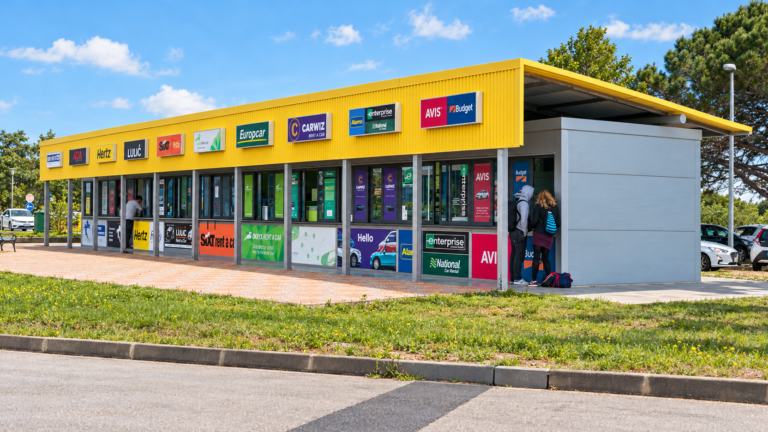
Photo: car rental offices at Zadar Airport, 27 May 2019 — Matti Blume / Wikimedia Commons, CC BY-SA 4.0. Edited for NOMADIY: bins removed, sunny lighting and an adjusted crop. The edited photo is also available under CC BY-SA 4.0.
Also see

American Express guide: Blue, Green, Gold and Platinum